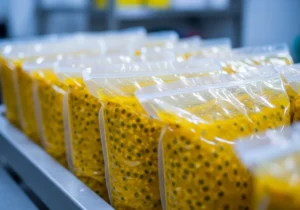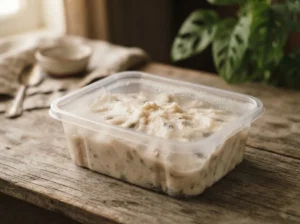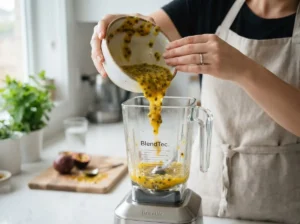

The ice cream industry works with a demanding ingredient: fruit. Its availability changes with the harvest, its sweetness varies between lots, and handling it consumes plant hours. That is why more manufacturers are formulating ice cream with fruit pulp instead of starting with fresh fruit. The pulp delivers the same fruit profile, but with consistent specifications and a much shorter process.
Why use pulp to make ice cream with fruit pulp
Pulp makes it practical and standardized to incorporate fruit into different formulations. In addition, it reduces dependence on the harvest and keeps flavors available year-round.
At Alimentos SAS, we process and preserve fruit precisely to overcome seasonality. This allows your plant to work with an ingredient that is ready for dosing.
The operational advantages are concrete:
- Consistent availability of mango, passion fruit, or blackberry, even outside the season.
- Standardized flavor, color, and acidity from one lot to the next.
- Less fresh-fruit handling because it arrives pulped, refined, and pasteurized.
- Process optimization because washing, peeling, and discarding are eliminated.
- Reduced losses, a factor that directly affects cost per liter.
What types of ice cream with fruit pulp can be made?
Pulp adapts to almost any frozen display. In fact, it works in both water-based and dairy-based mixes, as long as the formulation is adjusted.
These are the most common plant applications:
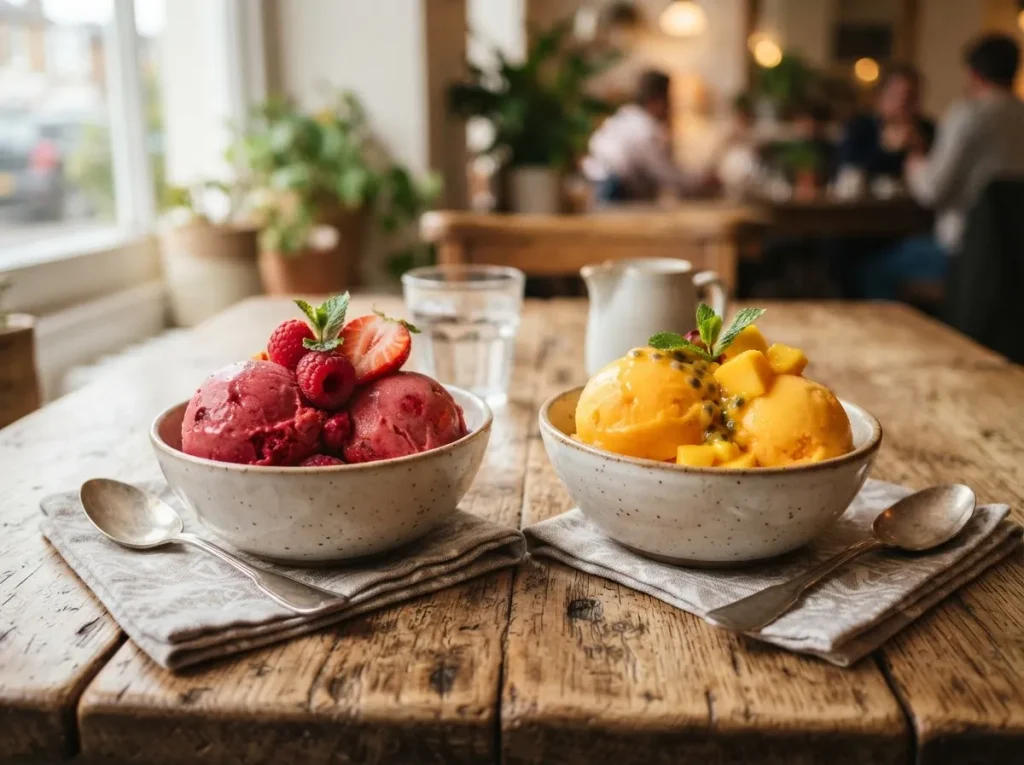
- Ice cream made with tropical fruits such as mango, passion fruit, soursop, pineapple, and papaya.
- Berry ice cream, especially strawberry, blackberry, raspberry, and blueberry.
- Sorbets and water-based ice cream, where fruit is the main ingredient.
- Dairy-based ice cream with fruit, with creamier, smoother profiles.
- Popsicles and frozen desserts that take advantage of the pulp’s natural color.
On the other hand, the trend supports this decision. The market recorded a 6% increase in ice cream and frozen yogurt launches over the last year, driven by products that combine indulgence and health (Cubas, 2025).
How to use pulp in the formulation of ice cream with fruit pulp
Industrial use follows a clear sequence. To do so:
- Define the base: dairy, plant-based, or water-based, according to the target product.
- Add the pulp to the mix before or after pasteurization, depending on your process.
- Adjust solids, sugars, and water to balance the freezing point.
- Homogenize the mix until the fruit is uniformly dispersed.
- Age, churn, and harden with temperature control at each stage.
However, avoid looking for a universal pulp percentage. The proportion depends on the fruit, its composition, the type of ice cream, total solids, sugar, and acidity. A passion fruit sorbet and a creamy mango ice cream do not allow the same dosage.
What effect does fruit pulp have on ice cream texture?
This is the critical point. Pulp adds flavor, but it also adds water, and free water freezes into crystals.
The size of those crystals determines the eating experience. Crystals between 10 and 20 microns create a smooth, creamy texture, while those larger than 50 microns produce a sandy sensation (Ice Cream Science, 2023).
Several factors influence this balance:
- The water content of the pulp, which increases the risk of crystallization.
- The fruit solids, which retain water and add body to the mix.
- Sugar, which lowers the freezing point and improves creaminess.
- Stabilizers and emulsifiers, which control free water during storage.
Why can ice cream with pulp become too hard?
The cause is usually an imbalance, not the pulp itself. When water increases without enough solids to balance it, the product hardens and loses its smoothness. Consequently, the solution is to recalculate solids and sugars before reducing the amount of fruit.
Which fruits work best in ice cream with fruit pulp
Not all fruits behave the same way. Each contributes a different profile of sweetness, acidity, and color.
These are the most commonly used in industrial ice cream:
- Mango: sweet, tropical, and highly versatile, with high soluble solids.
- Passion fruit: intense aroma and pronounced acidity, ideal for sorbets.
- Strawberry and berries: vivid color and good compatibility with dairy bases.
- Soursop: soft fibrous texture that enriches creamy formulations.
- Pineapple: refreshing profile, with moderate acidity and a recognizable aroma.
You can also combine them. For example, mango with passion fruit, mango with pineapple, strawberry with blackberry, and mango with coconut work very well. In addition, purées with sweeter profiles require less added sugar.
What challenges are there when making ice cream with fruit pulp
No process is free of obstacles. However, they can all be anticipated with technical data and laboratory testing.
The most common ones at the plant are:
- Excess water, which produces hard ice cream or visible crystals.
- Flavor variation between lots when the supplier does not control Brix levels.
- Texture changes during storage, especially with thermal shocks.
- High acidity, which can coagulate certain dairy bases when mixed cold.
Passion fruit illustrates that last point well. Its low pH requires careful incorporation into milk-based mixes, preferably with the base cold and stabilized.
Frozen or shelf-stable pulp for making ice cream
Both formats work. The choice depends on your infrastructure, not the product itself.
Frozen pulp offers clear advantages:
- Cold-chain preservation without chemical preservatives.
- Natural fit for operations that already have freezing capacity.
- Different dosing options according to batch size.
Shelf-stable pulp offers other benefits:
- Greater logistics flexibility and lower freezer-space consumption.
- No refrigeration required before opening, according to the product’s conditions.
- Easier inventory planning in plants with staggered production.
To decide, review your production volume, storage capacity, manufacturing frequency, turnover, and plant conditions.
How to choose fruit pulp for the ice cream industry
A technical purchase prevents costly reprocessing. Therefore, it is worth looking beyond the price per kilogram.
Always verify these points:
- Complete technical data sheet, including Brix, pH, and titratable acidity.
- Lot-to-lot consistency, supported by certifications such as ISO 22000 or HACCP.
- Storage conditions and shelf life declared by the manufacturer.
- Format, yield, and dosing practicality on your line.
- Final application, because a sorbet and a frozen yogurt require different profiles.
A common purchasing question is the difference between pulp and nectar: pulp is processed fruit without dilution, while nectar includes water and sugar. For ice cream production, pulp offers greater control over the formula.
Fruit pulp applications beyond ice cream
The same ingredient can perform across other lines in your portfolio. Thus, one purchase can support multiple developments.
Among the most common applications are:
- Beverages, juices, flavored waters, craft beers, and smoothies.
- Yogurts and dairy products with fruit.
- Desserts, mousses, and pastry preparations.
- Baking fillings that withstand the oven.
- Sauces and coulis for foodservice.
Fruit pulp for industrial applications
At Alimentos SAS, we start with selected fruits and extract the edible portion. The ingredient is then supplied to ice cream, refreshment, dairy, and confectionery applications.
Our industrial portfolio is organized as follows:
- Fruit pulp: a complete line of tropical fruits and berries.
- Long-life and aseptic fruit pulp: flexible logistics and simple storage.
- Frozen fruit pulp: sensory profile close to freshly processed fruit.
Formulating ice cream with fruit pulp is, above all, an exercise in technical balance. If you control water, solids, and sugar, you will obtain a creamy, stable product. And if you also work with a supplier that guarantees consistent specifications, your display will taste the same in January and December. Contact us and let’s evaluate together the pulp that best fits your formulation.
References
- Andros Chef. (2024, November 13). How to choose the best fruit purée for your artisan ice cream?
- Cubas, I. (2025, December 30). Ice cream 2025–2026: indulgence, data, and strategic innovation. The Food Tech.
- Ice Cream Mix. (2026, April 21). How to formulate artisan ice cream step by step.
- Ice Cream Science. (2023). Ice crystals in ice cream.