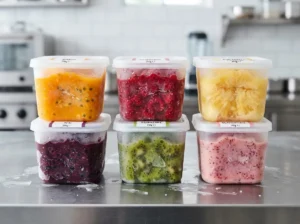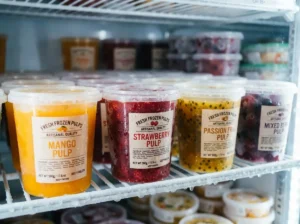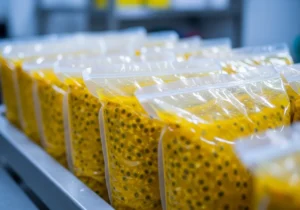

Snacks with fruit pulp consolidated as one of the most profitable categories for those formulating food on an industrial scale. Our frozen fruit pulp delivers real color, acidity, and aroma throughout the year, with a standardization that fresh fruit hardly sustains between harvests. For purchasing and research and development departments, that consistency translates into less waste, fewer recipe adjustments, and predictable batches.
Throughout this article, the formats with the highest commercial traction are detailed, along with a table to choose the appropriate pulp according to the manufactured product, and technical adjustments for sweetness, texture, and preservation defining the final result. Also, the most common doubts about using frozen pulp in new developments are resolved. The intention is to provide criteria applicable to the next formulation, not loose theory.
Snacks with fruit pulp: the formats that today drive the market
The appetite for small portions and clean nutritional profiles continues pushing the demand for fruit-based bites, and industry reports project a sustained growth for this category toward 2029 (Mordor Intelligence, 2025).
Behind that forecast lies a very specific habit change: consumers want to eat between meals without feeling they are giving anything up. Preparations starting from already processed fruit fit right there, because they allow controlling sweetness, texture, and portion size without resorting to unnecessary additives.
For the production area, furthermore, the pulp eliminates pulping, seed discarding, and agricultural supplier variability. These are the formats with the longest commercial trajectory:
- Paletas and ice creams. They absorb high fruit percentages without losing structure and work as a gateway to the impulse channel.
- Fruit gummies. They require acidic pulps so the flavor survives the sugar and the gelling agent.
- Fruit rolls or fruit leather. They dehydrate into a thin sheet and offer shelf life at room temperature, ideal for school lunchboxes.
- Muffins, pancakes, and waffles. The pulp provides moisture and natural color, which reduces the need for added colorants.
- Parfaits and yogurt bases. They allow visible fruit layers, a powerful visual argument at the point of sale.
- Energy bars. The pulp acts as a wet binder and adds fiber without unbalancing the protein profile.
Each of these formats demands a different raw material behavior, and that is where many projects stall. In this way, snacks with fruit pulp that perform well on shelves are born from a prior decision: choosing the fruit responding best to the thermal process and the target market flavor expectation.
How to choose the right pulp for each type of bite
Flavor selection in snacks with fruit pulp is not a matter of personal taste, but of a technical sheet. Three variables rule: soluble solids measured in Brix degrees, anticipating sweetness and yield; pH, conditioning microbiological stability and the behavior of gelling agents like pectin; and acidity expressed in citric acid, defining mouth contrast.
For instance, a mango with ranges from 15 to 24 °Brix behaves very differently from a blackberry at 6.5 to 8 °Brix, although both are called pulp. Colombia, by the way, consolidated its export position after fresh mango entered the U.S. market (Fresh Fruit Portal, 2023), which expanded the availability of tropical varieties for the industry.
The reference nutritional profiles of each fruit can be contrasted in public databases like FoodData Central (USDA, 2024). The following table summarizes the pairings working best in the plant:
| Bite | Recommended pulp | Preservation | Consumption occasion |
|---|---|---|---|
| Paletas and ice creams | Mango (15–24 °Brix) | −18 °C, continuous cold chain | Impulse channel and summer |
| Fruit gummies | Blackberry or passion fruit (pH 2.65–3.30) |
Ambient, hermetic packaging | Children’s lunchbox |
| Dehydrated rolls | Guava or mango | Ambient, individual film | Sports snack |
| Muffins and pancakes | Papaya or guava (pH 3.50–4.30) | Refrigeration or freezing | Breakfast and cafeteria |
| Parfaits and yogurts | Passion fruit or lulo (high acidity) | 0 to 4 °C | Point of sale and foodservice |
With this technical reading on the table, the next step is fine-tuning the parameters separating a pleasant prototype from a product ready to sell.
Texture, sweetness, and preservation in snacks with fruit pulp
Sweetness adjustment in snacks with fruit pulp rarely involves adding more sugar. When working with high Brix pulps, like mango, the cleanest route consists of reducing the sweetener and letting the fruit sustain the profile, a decision furthermore facilitating nutritional declarations against regulatory frameworks like the United States Food and Drug Administration (FDA, 2024).
In acidic pulps like passion fruit or blackberry, the balance is achieved the other way around: a touch of sweetness rounds out the acidity without dulling the fruity character the consumer sought. Texture depends on solid content and thermal management. In that sense, the best recipes with fruit pulp start from a simple principle: the less free water left in the matrix, the better the final bite structure will be.
In dehydrated rolls, that implies spreading the sheet with uniform thickness; in gummies, synchronizing the pH with the gelling agent activation; and in baked goods, compensating for humidity by reducing other formulation liquids. Applied research in food technology insists on validating these adjustments in a pilot plant before scaling.
Preservation closes the circle. A frozen pulp at −18 °C sustains its attributes for twenty-four months as long as the cold chain is not interrupted, and that backing transfers to the finished product. In this way, snacks with fruit pulp reaching the consumer well are, almost always, those respecting the temperature at each link.
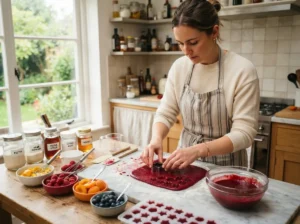
Frequently asked questions about snacks with fruit pulp
Development teams usually arrive with the same concerns when evaluating producing snacks with fruit pulp from processed raw materials instead of fresh fruit:
- Can frozen pulp be used for snacks? Yes, and in most cases it is preferable: it arrives standardized in Brix, pH, and acidity, which reduces variability between batches.
- What is the difference between pulp, puree, and jam? Pulp is sifted fruit without diluting or concentrating; puree has a finer texture; jam already incorporates sugar and prolonged cooking.
- What to do with leftover pulp from a batch? It can be redirected to yogurt bases, pastry fillings, or beverage mixes, always under immediate refrigeration or freezing.
- Which pulps work best with yogurt, oatmeal, or granola? Those with medium to high acidity, like passion fruit, blackberry, and lulo, because they contrast with milk fat without losing identity.
- How are already elaborated products preserved? It depends on the format: dehydrated ones tolerate ambient environments with a moisture barrier; frozen ones demand a constant −18 °C.
Resolving these questions early avoids costly reformulations and accelerates time to market. The next step is getting a supplier backing every data point with verifiable documentation.
Alimentos SAS: the raw material your next development needs
At Alimentos SAS we produce and market tropical fruit pulp as an industrial ingredient for beverages, ice creams, dairy, jams, and pastry. Our portfolio includes mango, blackberry, passion fruit, guava, lulo, papaya, curuba, and lemon, all obtained from selected fruit at its optimal ripeness point, without preservatives and unconcentrated. Each reference has a technical sheet documenting soluble solids, pH, acidity, microbiological profile, and heavy metals, besides pasteurization and metal detection as critical control points.
We handle presentations of 230, 250, and 397 grams, 1.5-kilogram bags, portioned boxes of ten units per 100 grams, and formats according to customer requirements, with twenty-four months of shelf life at −18 °C. If the team is evaluating offering snacks with fruit pulp for the next innovation cycle, write to us: technical sheets and samples will be sent so the decision is made with data in hand.
References
- Fresh Fruit Portal. (2023, January 3). Colombian fresh mangoes make U.S. market debut.
- Mordor Intelligence. (2025). Fruit snacks market size & share analysis: Growth trends & forecasts.
- U.S. Department of Agriculture. (2024). FoodData Central.
- U.S. Food and Drug Administration. (2024). Food labeling & nutrition.