
Saber where to buy soursop pulp is no longer a question of price; it has become a technical decision. In a beverage plant, ice cream shop, or distribution operation, the source of the ingredient determines sensory stability, yield, and regulatory compliance. Therefore, working with our frozen soursop pulp from a controlled source helps prevent lot-to-lot variation and simplifies operations.
In the following sections, you will find the actual sourcing channels, the points worth verifying in a technical data sheet before approving a supplier, the formats available for different types of operations, and the actual yield of one kilogram. You will also see what the cold chain involves and a ten-point checklist for comparing quotes.
Where to buy soursop pulp? B2B purchasing channels
Tropical fruit pulp is sourced through four routes, and none is interchangeable. Buying from the producer means dealing with the company that controls the entire process, from fruit receiving to packaging, which facilitates traceability and specification adjustments.
Distributors, in turn, provide regional coverage, although they add an intermediary to the technical information flow. Marketplaces solve urgent needs but rarely provide lot-to-lot consistency. Industrial and foodservice channels operate with contracts and documentation requirements. Defining where to buy soursop pulp starts with understanding what each route delivers.
Producer, distributor, or marketplace: what changes in practice
Buying from the manufacturer shortens the supply chain and improves access to the technical data sheet and support when a deviation occurs. Therefore, when an operation depends on a stable sensory profile, such as in a yogurt or fruit beer, that proximity matters more than a one-time discount. A distributor can consolidate references into one shipment, while marketplaces cover small trials without lot control. That difference defines where to buy soursop pulp in an industrial operation.
What should you review before deciding where to buy soursop pulp?
What supports a negotiation is documented evidence, and many quotes fall short here. In that sense, knowing how to choose fruit pulp suppliers starts with reading the technical data sheet rather than the marketing material. A sound document states composition, physicochemical parameters, microbiological limits, and storage conditions. These are the points that should not be missing:
- Fruit and origin: variety, source, and accepted maturity.
- Ingredients: declared preservatives, added sugar, or antioxidants.
- Physicochemical parameters: Brix, pH, and acidity, including the method used.
- Organoleptic characteristics: aroma, flavor, color, appearance, and texture.
- Storage: storage temperature and shelf life by product line.
- Traceability: lot, current health permit, and certifications.
- Consistency: parameters that are repeated from one shipment to the next.
With these data in hand, the comparison stops being a hunch and becomes a measurable evaluation when deciding where to buy soursop pulp.
Format, yield, and the cold chain: the variables behind the real cost
Price per kilogram says little if it is not considered alongside format and plant yield. In addition, portioned packaging reduces handling and waste when working on demand, while a larger-volume format lowers the unit cost when production is continuous. Neither is inherently better: it depends on consumption rate, available freezer space, and each product’s formulation.
What format is best for each type of operation?
The following table does not replace a consumption analysis, but it helps structure the conversation with the supplier. The greater the demand variability, the more sense portioned formats make; the more stable the demand, the more convenient an industrial format becomes. Therefore, a hotel with irregular banquets does not buy the same way as a nectar plant, so review your freezing capacity when deciding where to buy soursop pulp:
| Buyer type | Format to evaluate |
| Restaurant | Portions |
| Hotel | Portions or volume |
| Café | Portions |
| Ice cream shop | Larger volume |
| Beverage manufacturer | Industrial volume |
| Food manufacturer | Based on production and process |
How much does one kilogram of soursop pulp yield?
Yield is not a fixed number because the same pulp produces different results in nectar, a smoothie, or an ice cream base, as the water ratio and final concentration change. As a preparation reference, the manufacturer of the portioned format indicates 100 g of pulp for every 300 cc of drinking water, although the amount varies by recipe.
Frozen or fresh: what each route involves
Working with fresh fruit makes sense when the plant is close to the growing area, has its own pulping operation, and can absorb seasonality. Outside those circumstances, frozen format solves problems that whole fruit cannot. In fact, the trade-off requires maintaining the cold chain from shipment through use because improper thawing alters texture and color. The following advantages often influence the decision:
- Year-round availability, without depending on the harvest.
- Less handling in the plant and lower losses.
- Standardized sensory profile from one lot to the next.
- Planned storage according to inventory turnover.
- Immediate use, with no washing or preprocessing.
- Less waste by using only the required amount.
The decision comes down to assessing whether the operation can maintain that temperature throughout the chain without refreezing the product.
How to choose a soursop pulp supplier for your company
Soursop pulp reaches industries with different requirements. In beverages, it goes into juices, flavored waters, smoothies, and beer blends; in ice cream, it adds body and acidity; in dairy products, it is incorporated into yogurt; in baking, it works as a filling; and in hospitality, it supports daily production. Likewise, each application requires a different attribute, whether viscosity, color, or acidity. These are the ten points to verify:
- Review the technical data sheet and confirm its current version.
- Verify supply capacity against projected consumption.
- Compare formats according to the actual production pace.
- Evaluate required storage and transportation conditions.
- Review health permits and regulations in the destination market.
- Request samples and test them within the formulation.
- Compare price per kilogram against final yield.
- Evaluate lot-to-lot consistency through multiple analyses.
- Review delivery times and response to urgent needs.
- Confirm post-sale commercial and technical support.
A supplier that responds with documents rather than adjectives is the safest choice when deciding where to buy soursop pulp.
Frequently asked questions about where to buy soursop pulp
Questions that arise when evaluating suppliers tend to repeat, especially when the purchase involves volume or exports. Bringing them together in one section saves emails and speeds up purchasing decisions. The following answers are based on the product’s technical data sheet.
How can you buy soursop pulp in bulk?
With Alimentos SAS, you can find industrial formats and reliable ongoing shipments. This channel allows you to negotiate volume, specifications, and delivery times.
How should soursop pulp be stored?
The frozen product requires an uninterrupted cold chain and must not be refrozen. The shelf-stable aseptic line can be stored at a maximum of 22 °C, away from direct sunlight, and refrigerated after opening.
Which soursop pulp supplier is best?
At Alimentos SAS, we document your process, maintain lot-to-lot consistency, and meet the destination’s sanitary requirements.
Formats available from Alimentos SAS
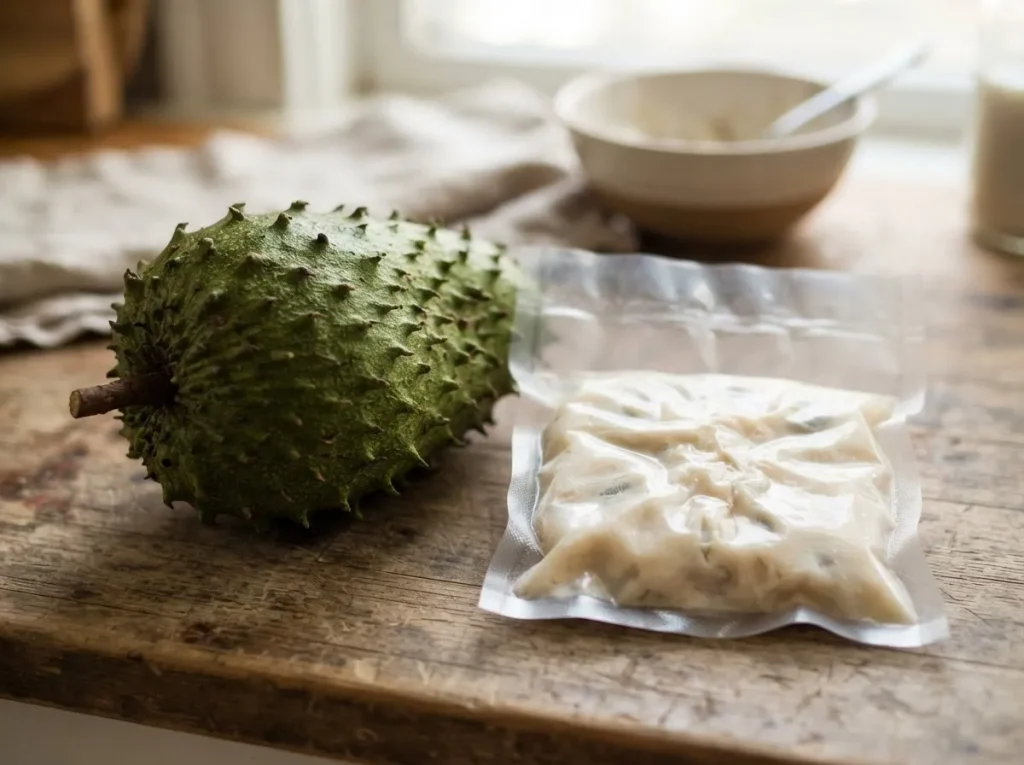
The shelf-stable line is packed in seven-layer high-barrier bags in 100, 150, 200, and 1,000-gram formats, with an eight-month shelf life. The industrial aseptic line uses a preformed bag with a filling valve in 2, 5, 20, and 200-kilogram formats and has an eighteen-month shelf life. This is complemented by the portioned frozen format, with ten 100-g pouches per box.
Why buy soursop pulp from Alimentos SAS?
At Alimentos SAS, we produce and market tropical fruit purées as industrial raw materials for beverages, ice cream, dairy products, jams, and baking.
Our aseptic soursop pulp is obtained by breaking down and sieving ripe fruit, without dilution or concentration, and is pasteurized to ensure safety. The technical data sheet declares soluble solids between 13.00 and 17.00 °Brix, pH between 3.00 and 4.00, and acidity between 0.50% and 1.00% as citric acid. The composition is limited to pulp and ascorbic acid as an antioxidant, with no preservatives, sanitary permit PSA-0002466-2020, and KOSHER and ISO 22000:2018 certifications.
The pulp works as a raw material for sauces, ice cream, desserts, and juices. If you already know where to buy soursop pulp, the next step is simple: request the current technical data sheet, ask for a sample, and validate it in your process.
References
- Food and Drug Administration. (2024). Hazard Analysis Critical Control Point (HACCP). U.S. Department of Health and Human Services.
- Ministry of Health and Social Protection. (2021). Resolution 810 of 2021: technical regulation on nutritional and front-of-pack labeling requirements for packaged foods. Republic of Colombia.
- Ministry of Health and Social Protection. (2022). Resolution 1407 of 2022. Republic of Colombia.
- Food and Agriculture Organization of the United Nations and World Health Organization. (2023). Codex Alimentarius: international food standards. FAO/WHO.