
Passion fruit pulp for baking has become an essential raw material for mousses, fillings, curds, toppings, and glazes. In fact, bakers also rely on it for many fast-selling desserts with steady demand in today’s food industry. However, choosing among the many formats on the market requires a detailed and analytical review of several key factors. That careful review allows you to achieve standardized, safe, and competitive results in every professional application. Among these critical elements, the physicochemical composition, storage conditions, and exact dosage in each formula stand out. Likewise, you should consider the ideal consistency and the very specific needs of each individual production process.
Additionally, recent trends in the global food industry highlight the strategic value of highly versatile tropical ingredients. As a result, companies can diversify their offering of high-quality commercial products in a meaningful way. In turn, this approach responds to increasingly demanding consumers who seek memorable, authentic, and refreshing sensory experiences in every bite.
What can you make with passion fruit pulp for baking?
Thanks to its natural acidity and intense aromatic profile, this versatile ingredient can transform any sweet preparation. Consequently, pastry chefs and product developers take advantage of this raw material in multiple creations such as:
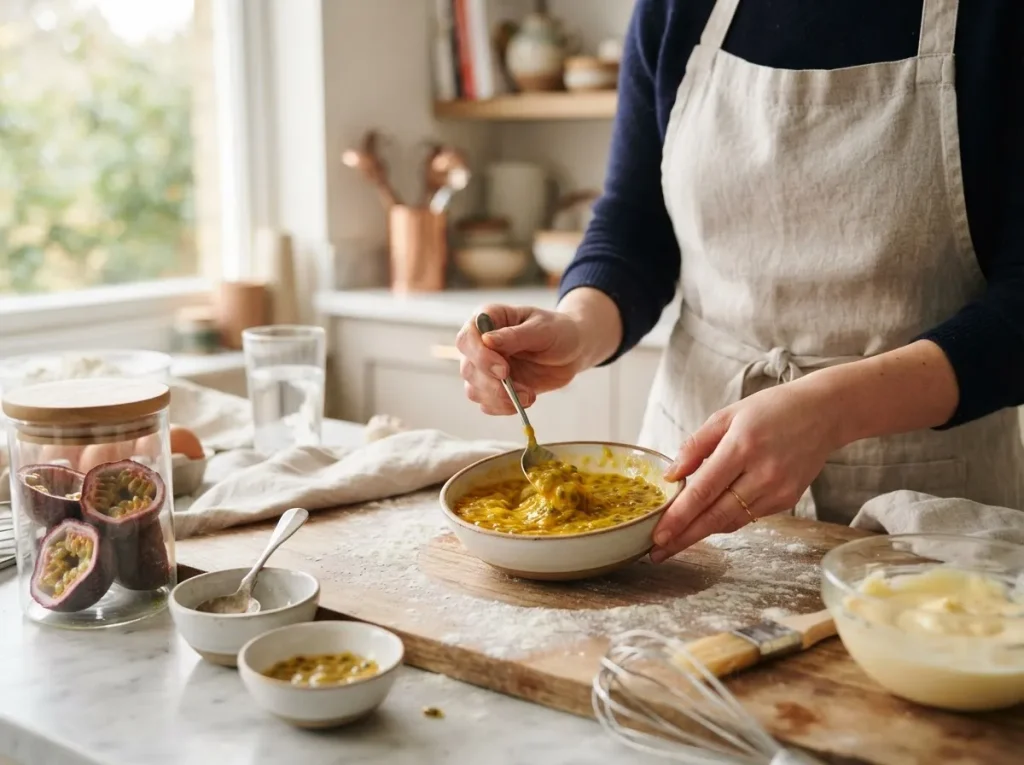
- Mousses and fillings: it blends in seamlessly, adding an airy texture and well-balanced citrus notes to each dessert.
- Curds and fruit creams: this pulp provides an ideal silky texture for artisan tarts and small tartlets in any bakery.
- Toppings and glazes: they deliver a signature shine and a vibrant flavor that enhances the visual presentation of desserts.
- Cheesecakes and tarts: the pulp works as a base or top layer, creating a refreshing contrast with dairy ingredients.
- Pairings with chocolate, mango, coconut, and other flavors: these combinations enhance the exotic notes that contemporary pastry professionals value so highly today.
How should you use passion fruit pulp?
Incorporating this ingredient efficiently requires you to follow certain technical parameters throughout the entire production line. For this reason, we recommend keeping the following key aspects in mind during the formulation stage:
- Adding the pulp to the formula. Add the ingredient at the right stage of the process so excess heat does not degrade its aromatic compounds.
- Controlling acidity, moisture, and sweetness. Adjust sugar levels and gelling agents according to the fruit’s natural pH to ensure a stable texture.
- Thawing methods. If you use frozen formats, thaw them gradually under refrigeration and avoid sudden temperature changes.
- Replacing liquids. Keep in mind that no universal ratio exists, since the replacement depends on the recipe’s soluble solids and water content.
Key characteristics of quality passion fruit pulp for baking
Ensuring excellence in finished products depends on selecting a raw material that meets strict industry standards. With that in mind, you should carefully review the following technical elements in every batch you receive:
- Consistency and sensory profile. The pulp should have a uniform texture and the intense aroma typical of ripe, healthy fruit.
- Fruit content and ingredients. Check for the absence of unnecessary additives and make sure the product retains its natural properties.
- Acidity and soluble solids. Monitor the Brix degrees and citric acid percentage to keep every one of your preparations uniform and reliable.
- Stability and consistency across batches. Make sure your supplier guarantees stable processes that prevent variations in final flavor or color.
- Format and ease of dosing. Choose practical formats that help you optimize working times in your pastry kitchen or production plant.
Frozen or shelf-stable passion fruit pulp: which is better for baking?
Choosing the right format directly affects both the logistics and the operating costs of your business. Therefore, it helps to compare the options available on the market according to their technical advantages:
- Preservation criteria. Frozen pulp requires a strict cold chain, whereas the shelf-stable version stays at room temperature until opening.
- Dosing options. Portioned formats make inventory control easier, while aseptic formats help you streamline large-scale production runs.
- Added sugar content. You can find pure options without sugar and others that include a specific percentage for direct applications.
- Main consideration. Evaluate your plant’s logistics capacity and your recipe’s specific needs to select the most suitable raw material.
Passion fruit pulp for baking vs. fresh fruit
Optimizing manufacturing processes remains a top priority for small and medium-sized businesses in the food sector. Accordingly, working with processed raw materials offers your operation several undeniable benefits, including the following:
- Greater standardization. This format ensures that flavor, color, and acidity remain consistent throughout every production cycle in your facility.
- Less fruit handling. It shortens operating times on the prep line and reduces fatigue among your staff members.
- Less waste. Processed pulp eliminates the losses that come from peels, seeds, and fruit that has started to spoil.
- Year-round availability. You can count on a continuous supply without depending on the seasonal fluctuations of each harvest.
- Easier production planning. Standardized inputs let you calculate your plant’s manufacturing costs and times with much greater precision.
How do you choose a supplier of passion fruit pulp for baking?
Selecting a truly reliable business partner is a fundamental strategic decision for your company’s long-term success. After all, the right supplier consistently guarantees the safety, quality, and commercial performance of your finished products. That is why we suggest rigorously evaluating the following technical criteria before signing any supply contract:
- Review the technical data sheet and composition in detail. Thoroughly examine the physicochemical parameters, the actual percentage of pure fruit, and the Brix degrees the manufacturer officially declares.
- Carefully evaluate formats and packaging. Confirm that the primary and secondary packaging fits comfortably with the operating scale and specific needs of your processing plant.
- Verify your actual storage conditions. Make sure you have the physical infrastructure and warehouse space to store the product properly without contamination risks.
- Analyze the estimated shelf life. Pay close attention to the recommended storage times under strict refrigeration as well as at controlled room temperature.
- Review traceability systems and batch control. Check that the manufacturer rigorously uses clear identification codes and tracking systems to ensure strict, continuous quality control.
Passion fruit pulp for baking from Alimentos SAS
At Alimentos SAS, we firmly support the demanding processes of today’s food industry with a specialized, robust catalog. Specifically, we designed this product line to fully meet the highest international quality standards in every format we offer. In this way, we consistently offer you highly versatile options for each particular production requirement of your business:
- Shelf-stable passion fruit pulp. This excellent, highly practical alternative dramatically optimizes warehouse storage logistics without requiring an inconvenient cold chain before opening. Moreover, you can purchase it directly and safely in its convenient 1000 g shelf-stable passion fruit pulp format.
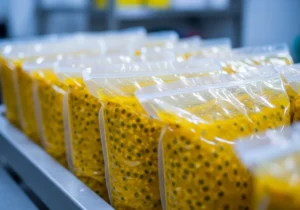
- Frozen passion fruit pulp. We developed this option with technology that preserves the fruit’s original organoleptic properties intact, fresh, and vibrant. It relies on a fast, optimal freezing process to lock in those qualities from the very start. You can get it immediately in practical industrial packaging, such as frozen passion fruit pulp in portioned kilo bags.
- Passion fruit pulp with sugar. We formulated this option specifically for complex preparations that require a pre-sweetened base. Its standardized ratio contains approximately 75% natural fruit and 25% refined sugar for reliable, repeatable results. Discover every technical detail in our Shelf-Stable Passion Fruit Pulp with Sugar 1000 g product listing.
Make the most of passion fruit pulp
Ultimately, the planned use of passion fruit pulp for baking offers a decisive competitive advantage to any operation. This benefit applies to pastry kitchens, fine patisseries, and food plants that aim to strengthen their quality and profitability. By prioritizing rigorous technical criteria, you can choose the right product specifications and preservation formats with confidence. Equally important, partnering with a strategic supplier like Alimentos SAS ensures optimal standardization across all your batches. In addition, your company will effectively reduce operating waste and give end customers an unmatched sensory experience in every formula you develop.
Furthermore, if you wonder where to buy passion fruit pulp that meets the industry’s highest requirements, turn to authorized manufacturers. These trusted partners guarantee a stable, certified supply chain that keeps your production running without unexpected interruptions. Similarly, to ensure maximum product durability after opening, you need to learn how to preserve passion fruit pulp. Proper cold storage plays a key role, as does respecting the recommended consumption times for shelf-stable versions. That way, you protect your business investment and keep the organoleptic properties intact in every single preparation.
References
- Andros Chef. (2024). The secrets to a perfect passion fruit purée: Tips and recipes.
- Brewster, E. (2026). The new tropical fruit palette. Food Technology Magazine. Institute of Food Technologists.
- FreshFruitPortal.com. (2024). Colombian passion fruits ready to enter the US market.
- FreshFruitPortal.com. (2025how to preserve passion fruit pulp, where to buy passion fruit pulp). Peruvian passion fruit regains ground.