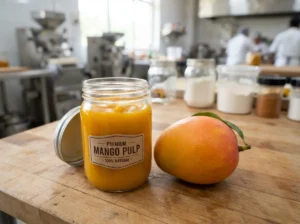

Mango pulp for micheladas stopped being a seasonal resource and became a purchasing decision that weighs on every glass. When a bar pours one hundred drinks in one night, the raw material decides the margin, not the recipe. Our long-life mango pulp delivers the same intensity in January and in October, glass after glass. Whole fruit, meanwhile, changes price, sweetness and availability almost every single week of the year.
The following sections explain what pulp contributes to a michelada and how it differs from purée and juice. You will also move from eyeballed pours to grams per drink, choosing the presentation your volume demands. Furthermore, you will review the technical criteria worth demanding from a supplier before you sign a purchase order. A direct comparison between the frozen format and the long-life format closes the section as well.
Mango pulp for micheladas: what it contributes to the drink
The michelada lives in contrast, and that tension defines the whole drink. Beer, acidity, salt and heat share one glass, and a single miscalibrated ingredient breaks that balance before the third sip. Mango, in turn, plays a bridging role: it softens the lime’s sharp edge and carries the heat without masking it.
That role, however, holds only when the fruit arrives with a stable concentration in every delivery. Our Colombian mango pulp spec sheet reports soluble solids between 15.0 and 24.0 °Brix, a pH of 3.60 to 4.30, and acidity from 0.30% to 0.70% as citric acid. Within that range, the drink behaves the same way batch after batch, without surprises on the line.
- Flavor: steady fruit intensity, free of the ripeness swings that whole fruit imposes on every batch.
- Color: an even orange tone that holds in the glass and improves the photo your customer posts.
- Body: adds density, so the beer foam keeps its structure through the first stir.
- Consistency: fluid, homogeneous texture, without fibers that clog the dispenser during service.
- Speed: removes peeling, pulping and washing precisely at the busiest hour of the night.
Once those five points settle, the conversation moves to firmer technical ground: what exactly you buy when you order pulp.
Mango pulp, purée or juice: why they are not synonyms
International recipe books use all three terms, and that mixture generates confusion at the moment of purchase. Juice, for instance, means a diluted liquid with low body; purée usually describes sieved and homogenized fruit. Pulp, according to the Colombian industry definition, covers the edible fraction, disintegrated and sieved, without dilution, concentration or preservatives.
The distinction matters, therefore, because each category yields differently and changes what every glass costs. Ordering juice when the formulation calls for pulp forces a higher dose to reach the same flavor. That adjustment means more product per glass and less margin at the close of every month.
From whole fruit to a ready-to-use portion
What to do with mango pulp is a question many bar teams answer late, after crates ripen unevenly. Ultimately, working with mango pulp for micheladas cuts that uncertainty at every stage of service. Waste from overripe fruit disappears, no peel or seed residue remains, and the portion arrives ready to weigh.
Availability adds another layer to the same argument, and the calendar exposes it very fast. Mango has harvest peaks, and a venue that serves the drink year-round cannot depend on them. In fact, Colombia opened access for fresh mango to the United States market in 2023. That milestone shows how much this fruit’s supply chain has matured over recent years (Fresh Fruit Portal, 2023).
How to dose the pulp without leaving it to each shift’s judgment
Recipes circulating online mention half a cup of purée per glass, a generous splash or amounts to taste. Such guidance suits home preparation, yet it fails operations needing identical results across two sites and three shifts.
Buyers who purchase mango pulp for micheladas in volume need a firmer reference point: grams per drink. Indeed, that figure connects flavor with cost, inventory and staff training, because every glass then carries predictable consumption.
Balance among mango, lime, chili and salt
Mango brings sweetness and body; lime brings acidity; chili and salt bring tension. Raising the fruit without adjusting the lime produces a flat drink, while excess acidity instead reads as aggressive. Set the pulp dose first, and then move the remaining components around that fixed anchor.
Moreover, the beer style also weighs on that equation far more than most menus admit. A light lager takes more fruit than a markedly bitter beer on the same menu. The same amount of mango pulp for micheladas may suit one list and overwhelm another.
From the bartender’s judgment to a written preparation sheet
Once the dose exists, the next step puts it in writing and makes execution simple. At that point, product format matters: portioned frozen mango pulp lets teams work in 100 g units. Such a concrete reference lets every staff member dose correctly without reaching for a scale.
With the dose fixed, cost per drink stops being an estimate and becomes plain arithmetic. If you know the grams per glass and the price per kilo, you obtain the fruit cost in every michelada. Consequently, you set your menu price on your own criteria, rather than by copying the bar across the street.
Frozen or long-life: which mango pulp presentation to choose
Admittedly, no universal answer exists here. The choice depends on sales volume, rotation, available storage space and your priority between portioning and cold-chain simplicity.
In addition, how to preserve mango pulp is the question that truly organizes this decision. Alimentos SAS frozen pulp holds at -18 °C and declares a 24-month shelf life, provided the cold chain never breaks. Its long-life counterpart needs no refrigeration before opening; afterward, it requires refrigeration and use within a few days. We summarize both formats in the following table:
| Criterion | Frozen (10 × 100 g) | Long-life (1,000 g) |
| Dosing | Ready 100 g portion | Requires measuring from the container |
| Storage | Freezing at -18 °C | No refrigeration before opening |
| Declared shelf life | 24 months at -18 °C | According to the product spec sheet |
| Once opened | Use promptly, keep it cold | Refrigerate and use within a few days |
| Best suited to | Operations that prioritize portioning | Operations with little freezer space |
Read this way, the table names no winner: it names which operation each format belongs to. Mango pulp for micheladas performs in both formats, and only the workflow you build around it actually changes.
What to review before closing the purchase
Choosing a mango pulp for micheladas never reduces to a quick sample at the counter. Tasting settles flavor, yet it leaves out the information that sustains an operation for a full year. That information covers composition, batch-to-batch stability, format, declared shelf life and real supply capacity.
Accordingly, a short verification before the order saves rework and avoids the costliest scenario of all. That scenario means switching fruit mid-season and reformulating the entire drinks menu under pressure.
- Composition: fruit and antioxidant, with no preservatives or undeclared dilutions of any kind.
- Technical parameters: °Brix, pH and acidity ranges that the product spec sheet publishes openly.
- Batch-to-batch consistency: comparable color, aroma and texture across different deliveries throughout the year.
- Format: presentations that match your dosing routine and your available storage space.
- Traceability: an identified batch and documentary backup available whenever you request it.
- Supply: sustained deliveries during high season, not only on the first order.
Likewise, a supplier answering those six questions directly also answers the phone when product runs short on Friday night.
Alimentos SAS: mango pulp for micheladas with technical backing
At Alimentos SAS, we produce tropical fruit pulp as a raw material for beverages, ice cream, dairy, jams and pastry. Specifically, our mango pulp carries no preservatives and includes ascorbic acid as its only antioxidant.
For a bar, the decision runs through three references, each one serving a distinct purpose. The long-life presentation in 1,000 g suits anyone who prioritizes simple storage above everything else. Frozen cases of ten 100 g units help when portioning takes priority on the busy line. Finally, our long-life mango pulp with sugar adds sweetness and demands an adjustment to the drink formulation.
If your operation already knows how many grams each glass takes, the next step stays short. Write to Alimentos SAS, request the spec sheet you need, and test the yield behind your own bar. In the end, the right mango pulp for micheladas is the one your team repeats without thinking twice.
References
- Fresh Fruit Portal. (2023, January 3). Colombian fresh mangoes make U.S. market debut.
- M., N. (2024, January 12). Cómo preparar una auténtica michelada mexicana. El País.