Reviewing fruit pulp export requirements before closing an international deal helps you avoid port holds and rejected batches. In fact, anyone managing fruit pulp exports or buying this ingredient for beverages, ice cream, and dairy knows each market has its own rules.
This guide covers the documents exporters process in Colombia and the sanitary controls behind each batch. You will also see what the FDA requires for US entry, how frozen and shelf-stable logistics differ, and what to ask suppliers before you approve them.
What are the fruit pulp export requirements?
In practical terms, fruit pulp export requirements fall into five areas: product safety, documentation, destination rules, packaging and transport, and batch testing or certifications. There is no single list that works for every country where buyers import this ingredient.
Each health authority and each individual buyer sets its own specific demands for imported food ingredients. Consequently, the same product can enter one market without setbacks and face a hold at the border in another. To make sense of the landscape, it helps to understand what each of these five areas covers:
- Sanitary requirements: food safety, microbiological control, and good manufacturing practices.
- Export documentation: technical, commercial, and customs records for the shipment.
- Destination country requirements: registrations, prior notices, and labeling rules.
- Packaging, labeling, and transport: conditions that preserve the product during the journey.
- Certifications and testing: lab results and seals that the authority or the client requests.
With this map in place, the next step is to review what exporters prepare in Colombia before dispatch.
Documents and fruit pulp export requirements from Colombia
A large share of fruit pulp export requirements from Colombia goes through INVIMA, the national food and drug regulator. The agency has dedicated procedures for the Sanitary Inspection Certificate (CIS) on exports of food and food and beverage ingredients.
That said, a certificate only carries weight when it reflects what actually happens on the plant floor. Documentation and sanitary management move together, since the paperwork records what the batch already proved in the lab.
The documents that travel with each shipment
The destination country and the sales contract ultimately define the final list of required paperwork. Even so, most export operations bring together the following supporting documents for every single shipment:
- Technical data sheet: composition, specifications, shelf life, packaging, and storage.
- COA (certificate of analysis): microbiological and physicochemical results for the batch.
- Certificate of origin: grants access to tariff preferences; depending on the trade agreement, DIAN or the exporter issues it.
- Sanitary or inspection certificate: the INVIMA CIS, when the destination or the buyer requires it.
- Commercial and transport documents: invoice, packing list, export declaration, and shipping document.
Having them ready before dispatch shortens time at the port and simplifies the importer’s paperwork on arrival.
Food safety, testing, and batch traceability
With fruit pulp, suppliers prove food safety through data rather than through claims or assurances. Microbiological tests confirm the absence of pathogens before any batch leaves the plant for its destination. Physicochemical tests, on the other hand, check Brix, pH, and acidity against the specifications the client agreed to.
On top of that, suppliers must control pesticide residues, heavy metals, and other contaminants in every lot. Traceability completes the picture, since teams must track each batch from incoming fruit to container under good manufacturing practices.
What about the international certifications that buyers so often mention when they negotiate with suppliers? No single certification is mandatory for every fruit pulp export, regardless of the destination market involved. ISO 22000 or Kosher usually reflect buyer demands, not universal law, though many industries use them to qualify suppliers.
United States: Fruit pulp export requirements under the FDA
For US beverage, ice cream, and dairy manufacturers, imported pulp is a common ingredient in daily production. The FDA requires importers to verify that suppliers produce food with protection equivalent to US standards and without labeling issues.
In practice, exporters and their clients share the fruit pulp export requirements for this market between them. Neither side can fully delegate its part, and an oversight at either end leads to a shipment on hold.

Facility registration and Prior Notice
Two procedures take place before the goods arrive, and each one comes with precise deadlines that exporters must meet:
- FDA registration: the facility must hold an active registration, designate a US agent, and renew every two years, between October 1 and December 31 of even-numbered years.
- Prior Notice: this is the advance notice for each shipment. Filers submit it up to 15 days before arrival and at least 8 hours ahead by sea or 4 hours by air.
Since 2026 is a renewal year, it makes sense to confirm that your supplier’s registration remains current.
Labeling, importer, and FSVP: When does each one apply?
Labels must appear in English and include the product name, ingredients, net contents, and manufacturer or distributor details. Requirements also change depending on whether the pulp arrives in bulk for industrial use or in retail packaging for consumers.
For its part, the Foreign Supplier Verification Program (FSVP) requires the importer to evaluate its supplier before bringing food into the country. That same rule exempts juice importers who comply with the import provisions of Juice HACCP from these obligations.
Is fruit pulp subject to Juice HACCP?
It all depends on the specific product and its intended use within the buyer’s operation. The regulation defines juice as fruit or vegetable liquid, purees of edible portions, and concentrates that firms sell as such or use as beverage ingredients.
For that reason, certain pulps that go into beverages can fall within its scope, although not all pulp does automatically. When the rule applies, the processor operates under a HACCP plan for that specific product.
Frozen or shelf-stable pulp: Packaging, transport, and shelf life
Among the fruit pulp export requirements that weigh most in daily operations are batch consistency, clear shelf life, and storage-appropriate packaging. The product format, in turn, determines much of that equation for both exporters and buyers.
To be clear, frozen pulp and shelf-stable pulp do not follow the same logistics route at all. Nor is there a universal temperature that works for every pulp, format, and destination market. The right one is whatever each product’s technical data sheet specifies, and teams plan transport around it.
Frozen pulp and the cold chain
For anyone weighing how to export frozen fruit pulp, the starting point is the cold chain from plant to buyer. The product travels in refrigerated containers with temperature logging, because any break affects texture, color, and microbiological stability.
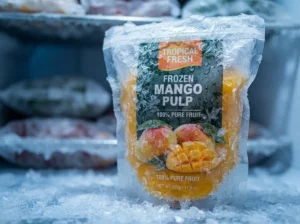
This format works well when the buyer has freezer rooms and handles the product in portions. Frozen mango pulp in portioned packs, for example, makes dosing easier in ice cream shops or smoothie lines without excess thawing.
Shelf-stable pulp and aseptic transport
Shelf-stable pulp goes through heat treatment and aseptic packaging that let it keep without freezing, according to its data sheet. As a result, it simplifies international shipping and opens up options for clients who lack cold storage infrastructure.
Which option makes more sense for a buyer who plans regular international purchases of fruit pulp? Neither format is better by definition, since each one solves a different set of logistics needs. Ultimately, the choice depends on distance, the buyer’s infrastructure, available storage, and the final application.
What to check before buying fruit pulp for import
Procurement and R&D teams comparing fruit pulp exporters look beyond the price per kilo when they shortlist suppliers. Many of them cross-check FAO agricultural production and trade statistics with their own technical evaluation. Before approving any supplier, it is worth taking the time to verify the following points:
- Production capacity and stable supply throughout the year.
- Technical data sheets, certificates of analysis, and batch-level results.
- Consistency in flavor, color, Brix, and viscosity.
- Shelf life compatible with your operation.
- Logistics capacity and proven export experience.
- Command of the fruit pulp export requirements for the destination country.
A supplier who answers these questions with ease saves the client trials, formulation adjustments, and unpleasant surprises.
Fruit pulp exports from Colombia with Alimentos SAS
Overall, meeting fruit pulp export requirements becomes simpler when your supplier has already turned them into routine practice. Alimentos SAS brings 25 years of export experience, ISO 22000 and Kosher certifications, FDA registration, and microbiological, heavy metal, and multi-residue testing.
Our refrigerated and aseptic logistics support both frozen pulp and the formats that travel without refrigeration. If your next formulation needs to go far, the fruit pulp we offer at Alimentos SAS is a good place to start a quote, data sheet in hand.
References
- Hazard Analysis and Critical Control Point (HACCP) Systems, 21 C.F.R. pt. 120 (2026).
- U.S. Food and Drug Administration. (n.d.-a). FSMA final rule on foreign supplier verification programs (FSVP) for importers of food for humans and animals.
- U.S. Food and Drug Administration. (n.d.-b). Juice HACCP.
- U.S. Food and Drug Administration. (n.d.-c). Prior notice of imported foods.
- U.S. Food and Drug Administration. (n.d.-d). Registration of food facilities and other submissions.