
Purchasing and research teams review every detail of how to make passion fruit juice from pulp before selecting raw ingredients. Specifically, frozen passion fruit pulp serves as an ideal foundation for new formulations requiring extended storage and simple sweetening.
Throughout this article, you will discover base pulp ratios, balanced mixing steps, and volume calculations for larger production batches. Additionally, you will examine differences between product formats, corrective actions for failed batches, and essential supplier evaluation questions.
How to make passion fruit juice from pulp: the base ratio
Before scaling any formula, technical teams usually establish a reliable reference ratio for consistent initial trials. As a starting point, operators mix one part pulp with approximately three parts cold water during testing. Furthermore, specialists adjust this liquid ratio afterward based on batch concentration and existing sweetener levels.
This proportional relationship matches the preparation method recommended in the technical data sheet for product formulations. Moreover, that official document also considers using whole milk as an alternative liquid base for creamy applications. For teams documenting how to make passion fruit juice from pulp in operational manuals, adding sweetener gradually prevents flavor imbalances. This careful approach matters because every batch of natural tropical fruit maintains natural variations in acidity.
- Estimated preparation: 5 minutes per test batch.
- Method: mix or blend using brief pulses.
- Initial ratio: 1 part pulp to 3 parts water or milk.
- Sweetener: add after tasting the base batch.
- Ice or chilling: add right before packaging or serving the sample.
Ingredients and utensils that the formulation team will need
For a production pilot run, operators need few ingredients, but they must measure each item precisely. Frozen pulp arrives as a natural product, undiluted, unconcentrated, and free from artificial chemical preservatives. Consequently, this pure state simplifies calculating the actual soluble solids contribution within the final product formula. Cold potable water serves as the dilution base, while developers define sweetener and ice according to target sensory profiles. Ultimately, documenting how to make passion fruit juice from pulp with proper utensils prevents unwanted variations between trial batches.
- Passion fruit pulp (frozen, long-life, or sweetened, depending on the line).
- Cold potable water or milk, according to the target formulation.
- Sugar, panela, honey, or sweetener, without setting a universal quantity.
- Mixing jar or tank with a known volume capacity.
- Scale or graduated cylinder to measure each component accurately.
- Strainer, only if the pulp contains seeds or fibers to remove.
How to make passion fruit juice from pulp step by step
The specific order of preparation steps directly influences the final consistency and texture of the product. Initially, technical operators should inspect the available pulp type and defrost it under controlled, sanitary temperature conditions. Next, developers mix the pulp with a smaller water portion than calculated to leave room for precise adjustments. Tasting the batch before adding sweetener represents an essential step that production teams should never skip. In practice, tropical passion fruit preserves natural acidity levels that vary noticeably from one harvest to another.
The following practical guidelines explain how to make juice with passion fruit pulp reliably across any production shift:
- Check whether the pulp is natural or sweetened, and whether it contains seeds.
- Thaw only the amount required for testing, following supplier instructions.
- Mix the pulp with part of the total water before completing the final volume.
- Taste the result before adding any additional sweetener to the batch.
- Adjust water and sweetness gradually until achieving the desired target profile.
- Chill or add ice at the end, remembering that melting ice slightly dilutes the mixture.
How to make passion fruit juice from pulp on a larger scale
A universal pulp ratio per liter does not exist because every commercial format features a distinct concentration level. In fact, certain commercial fruit preparations available on the market already include added sugar within their baseline formulation. Therefore, research and development teams should perform tests using the specific batch intended for full production runs.
Understanding how to make passion fruit juice from pulp at larger scales requires reviewing technical product data sheets. These technical documents specify soluble solids between 12 and 14 °Brix alongside citric acid levels between 2.5% and 4.0%. Such standardized values indicate exactly how much water the formula accepts without losing natural body or flavor.
- Mild profile: one part pulp to four parts water, ideal for light refreshing beverages.
- Balanced profile: one part pulp to three parts water, the most common starting point.
- Intense profile: one part pulp to two parts water, designed for concentrated beverage bases.
For larger industrial batches, production managers divide the desired final volume by the total parts of the selected formula. This mathematical calculation reveals the required pulp quantity, while the remaining volume represents the necessary dilution liquid. Validation of these figures through a pilot trial remains essential before committing to full-scale manufacturing runs. Indeed, actual yield varies slightly between fruit lots due to natural seasonal changes in raw materials.
Differences between frozen and long-life Pulp
Before deciding how to make passion fruit juice from pulp using a specific raw material, production managers must evaluate format differences:
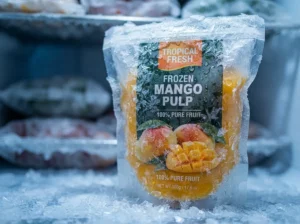
- Frozen pulp preserves the authentic organoleptic profile of mature fruit without applying thermal concentration processes, requiring an uninterrupted cold chain.
- Long-life shelf-stable formats prioritize product stability before opening, while sweetened options streamline processing steps in manufacturing plants.
- Anyone currently evaluating where to buy passion fruit pulp for their manufacturing plant typically compares these three distinct options.
Presentations by Alimentos SAS
Alimentos SAS manufactures frozen pulp by crushing and sieving healthy, mature tropical fruit without adding chemical preservatives or concentrates. This frozen product maintains peak quality for up to twenty-four months at minus eighteen degrees Celsius under uninterrupted cold storage. Physicochemical parameters between 12 and 14 °Brix and pH 2.80 to 3.30 deliver exceptional formulation predictability for quality control managers.
Additionally, long-life options allow room temperature storage before opening, according to commercial specifications for each specific product line. However, plant operators must refrigerate long-life packages immediately after opening to preserve product freshness and safety.
How to obtain passion fruit juice at the perfect point
When working with pre-sweetened pulp, operators should verify sugar percentages before adding water and evaluating sweetness levels. Regarding blending or straining, processing decisions depend entirely upon the target texture required for the final beverage product. A short pulse integrates water and sweetener effectively, whereas straining applies only when removing seeds or achieving smooth textures.
- If the batch tastes too acidic: add sweetener gradually alongside a small amount of cold water.
- If it tastes too sweet: incorporate unsweetened pulp, when available, and adjust with additional water.
- If it tastes watery: add more fruit pulp and reduce ice before re-evaluating flavor balance.
- If it tastes too thick: add cold water in small increments until reaching desired liquid fluidity.
Formulation variants and frequently asked questions
How to make passion fruit juice from pulp does not have a single answer when exploring versatile industrial formulation options. When combined with fresh milk, this fruit pulp creates unique dairy beverages featuring a controlled acidic flavor profile. Without added sugar, the pulp functions as a neutral ingredient for formulations seeking reduced sugar content in market products.
Furthermore, it serves as a base for smoothies when mixed with frozen fruit or yogurt in commercial setups. It also enhances specialty lemonades by combining two natural sources of fruit acidity within a single refreshing drink:
- How much water should production operators add for every hundred grams of passion fruit pulp? That ratio depends on batch concentration, though one part pulp to three parts water provides a solid starting point.
- Is defrosting the passion fruit pulp necessary before using it in the beverage production process? Plant operators should always follow supplier instructions because controlled defrosting facilitates accurate, highly precise ingredient measurement.
- Must industrial production teams always sweeten the fruit mixture during the overall product formulation process? That decision depends entirely on desired target acidity and whether the selected pulp already contains sugar.
- When should plant manufacturing staff filter or strain the liquid fruit mixture during standard beverage processing? Straining applies only when fruit batches retain seeds or when product standards require a completely smooth texture.
Alimentos SAS your reliable partner for your production line
After reviewing how to make passion fruit juice from pulp across different scenarios, selecting a reliable supplier becomes critical. In industrial purchasing, product traceability, microbiological stability, and batch consistency carry greater weight than initial raw ingredient pricing.
Alimentos SAS produces and markets tropical fruit puree under core values of honesty, responsibility, service, quality, and teamwork. The company supplies frozen pulp with documented parameters on technical sheets, simplifying quality assurance tasks for manufacturing teams:
- To control formula sweetness: passion fruit pulp with no added sugar.
- To work with exact portion sizes: portioned frozen passion fruit pulp.
- To store without a cold chain before opening: long-life shelf-stable pulp.
- To simplify sweetening in manufacturing: passion fruit pulp with added sugar.
Review our products and request the technical data sheet for our long-life passion fruit pulp.
References
- Mordor Intelligence. (2026). Tamaño y participación del mercado de concentrado de frutas – tendencias de crecimiento y pronóstico (2026 – 2031).
- Leal, K. (2026, July). Maracuyá: propiedades, 10 beneficios y cómo consumirlo. Tua Saúde.