
Do you know where to buy mango pulp without risking the quality of your final product? Ultimately, the answer depends on several factors your company should review before signing any supply agreement.
Supplier selection directly influences finished-product quality and the continuity of your supply throughout industrial operations. Moreover, it affects the operational efficiency of the entire production line from receiving through final processing.
Before purchasing, your company should evaluate relevant technical, logistical, and commercial considerations with equal attention. Often, teams overlook these details during rushed negotiations that prioritize immediate availability over long-term reliability. An unreliable supplier can cause delays, flavor variations, and extra costs that disrupt the entire operation. Below, we review what to consider, available formats, and how to evaluate a specialized fruit-pulp manufacturer.
What should you consider before deciding where to buy mango pulp?
Before deciding where to buy mango pulp, look beyond the price per kilogram and consider overall supplier performance. The following factors often distinguish a dependable supplier from one that creates recurring operational problems:
- Raw material quality. The source mango should meet clear, defined standards for ripeness, color, flavor, and overall condition.
- Batch-to-batch consistency. Each lot should maintain the same sensory profile without altering formulas or delaying the customer’s production schedule.
- Year-round availability. Fruit seasonality should not disrupt your industrial production schedule or create unexpected supply gaps during peak demand.
- Supply capacity. The supplier should cover current volume requirements and support projected growth over the medium and long term.
- Traceability and food safety. Quality certificates consistently confirm compliance with applicable sanitary standards for every shipment entering your facility.
What type of mango pulp does your production process require?
Knowing where to buy mango pulp also means identifying which format best fits your specific production line. In practice, industrial markets commonly offer the following presentations for different storage, logistics, and formulation needs:
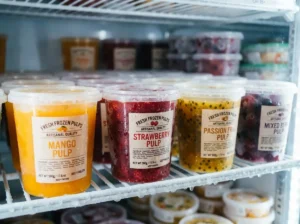
- Frozen mango pulp. It preserves fresh fruit’s sensory characteristics while requiring an uninterrupted cold chain throughout storage and distribution.
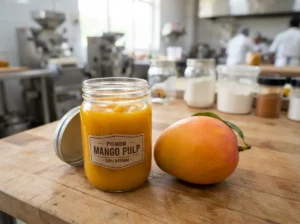
- Shelf-stable mango pulp. It stays at room temperature before opening, which significantly simplifies warehousing and distribution logistics throughout operations.
- Shelf-stable sweetened mango pulp. Manufacturers design it for beverages and formulas that require a defined sweetness profile in commercial production. Understanding these differences prevents unnecessary purchases and helps your team manage the annual budget more precisely.
How should you choose the right format?
The appropriate format depends on your cold-storage capacity and the volume your facility processes each week. If your plant already operates a cold chain, frozen pulp generally preserves flavor more effectively. Consequently, the final result closely resembles freshly cut mango in flavor, aroma, and overall sensory character.
However, shelf-stable formats work better when your company wants simpler logistics and lower storage costs. This option reduces dependence on continuous refrigeration throughout the production and distribution process for industrial facilities. Carefully evaluating both scenarios helps prevent disruptive supplier changes midway through the season each year.
Which industries purchase mango pulp?
Many industries use mango pulp as an essential raw material for their daily manufacturing processes. Before deciding where to buy mango pulp, identify which of these categories most closely matches your company:
- Beverage manufacturers. Juices, flavored waters, beers, and smoothies incorporate fruit pulp into their core formulations and commercial product lines.
- Dairy industry. Fruit yogurts require stable pulp that maintains the intended texture throughout processing, filling, and storage.
- Industrial baking and pastry. Fruit fillings require consistent texture and low free-water content for dependable production performance across commercial batches.
- Ice cream and frozen desserts. Pulp adds natural flavor without compromising product texture throughout freezing, distribution, and subsequent frozen storage periods.
- Food Service and HORECA. Restaurants and food-service operations prepare varied beverages and desserts with fresh fruit pulp throughout regular service periods.
- Sauce and dressing manufacturers. Mango pulp adds body and flavor to varied sweet and sweet-and-sour preparations across commercial food production.
Identifying your category within this list helps define the most appropriate purchase volume and product presentation.
How should you evaluate a mango pulp supplier?
Evaluating a supplier before deciding where to buy mango pulp requires reviewing much more than its available product catalog. Accordingly, request complete technical data sheets, representative samples, and verifiable references from active industrial customers.
Additionally, confirm that the manufacturer holds internationally recognized certifications such as ISO 22000, HACCP, and KOSHER. A favorable standing with health authorities such as the FDA further strengthens confidence in the supplier. Transparent suppliers readily share this information without requiring repeated requests during commercial negotiations or supplier evaluations. In many cases, that initial transparency indicates how the long-term commercial relationship will function over time.
Frozen or shelf-stable pulp: which should you buy?
Both formats serve different functions within a modern industrial operation and support distinct production requirements. The decision about where to buy mango pulp in either format depends on your specific production process.
Available infrastructure and processing volume also influence which alternative provides the strongest operational fit for each facility. Therefore, no option works best universally; each production line requires the format that matches its conditions.
Advantages of frozen pulp
Frozen mango pulp retains the original fruit’s aromas and natural color more effectively during storage. This option suits commercial processes seeking a sensory profile that closely resembles freshly cut fruit in finished products.
Maintaining an uninterrupted cold chain from receiving through final use remains essential for product quality. Moreover, this practice helps preserve the pulp’s sensory properties more effectively (Global Cold Chain Alliance, n.d.).
Many companies also ask how to preserve mango pulp after thawing so they can avoid unnecessary waste.
Advantages of shelf-stable pulp
Shelf-stable mango pulp needs no refrigeration before opening, which considerably simplifies transportation and warehouse planning. This format works well for facilities with limited storage space or long, complex distribution routes.
Many companies choose where to buy mango pulp in shelf-stable formats specifically because of this logistical advantage. Additionally, it reduces potential losses caused by occasional cold-chain interruptions during transportation or warehouse handling.
Factors to consider according to production volume
Before deciding where to buy mango pulp for high-volume operations, carefully review the total operating cost. High, consistent volumes often favor frozen pulp because its cost aligns well with expected sensory performance.
Variable or seasonal volumes generally adapt better to available shelf-stable pulp formats for flexible inventory planning. Furthermore, this option supports inventory buildup without requiring a continuous cold chain throughout the year. Reviewing both scenarios with real operating figures prevents purchasing decisions based solely on intuition during procurement planning.
How can you ensure a continuous mango pulp supply?
Knowing where to buy mango pulp is only the first step toward securing a continuous supply. Therefore, successful planning requires close coordination between your company and the selected supplier for long-term reliability:
- Demand planning. Sharing consumption forecasts helps manufacturers schedule production more accurately and prepare capacity for anticipated purchasing cycles.
- Scheduled purchasing. Recurring orders prevent inventory shortages during periods of high seasonal demand and improve procurement visibility.
- Inventory control. A clear rotation system prevents losses from expiration or deterioration while supporting orderly warehouse management.
- Long-term supplier relationships. Mutual trust supports faster adjustments when sudden demand changes affect purchasing or production schedules throughout the year.
Together, these practices reduce unpleasant surprises during the months when consumption and production requirements increase.
Why work with a specialized fruit-pulp manufacturer?
Working with a specialized manufacturer makes deciding where to buy mango pulp much easier for daily operations. Alimentos SAS has developed, produced, and marketed fruit pulps and nectars for industrial customers since 1981. Moreover, independent evaluations have assessed our processes against internationally recognized quality standards for consistent compliance.
Using one reliable supplier reduces the administrative burden of managing multiple contracts and food-safety audits. Additionally, it helps teams resolve unexpected issues through one direct and consistent communication channel during operations.
Portfolio for different industrial applications
Before deciding where to buy mango pulp, review the available portfolio according to your specific application requirements:
- Shelf-stable mango pulp, designed for manufacturers seeking convenient logistics and room-temperature storage before opening the package.
- Frozen mango pulp, suitable for processes that prioritize the fruit’s sensory characteristics and already operate a cold chain.
- Finally, shelf-stable sweetened mango pulp, developed for beverages and formulations that require a defined sweetness profile.
Each presentation includes its own technical data sheet, which your team can review before completing the purchase.
Quality and consistency for industrial processes
Buying mango pulp from a supplier with clear technical specifications greatly reduces variation risks between different production lots. Therefore, understanding where to buy mango pulp before signing a long-term contract supports better sourcing decisions.
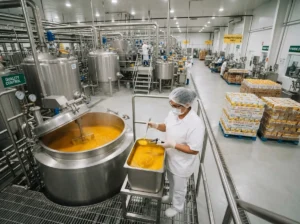
At Alimentos SAS, we maintain consistent quality control across every production lot throughout regular manufacturing operations. Additionally, we respond quickly to growing demand from our industrial customers across multiple industry segments. This level of consistency helps teams plan production with greater confidence and fewer unexpected adjustments.
Support for product development
Working with a partner that understands your industry’s requirements makes innovation and future scaling projects easier. At Alimentos SAS, we support customers from initial formulation through larger-scale production and commercialization for industrial applications.
This close collaboration makes deciding where to buy mango pulp easier without relying on additional intermediaries. Moreover, technical support helps teams resolve formula adjustments without losing valuable development or production time.
References
- U.S. Food and Drug Administration. (n.d.). Food. U.S. Department of Health and Human Services.
- Global Cold Chain Alliance. (n.d.). Cold chain.
- Global Cold Chain Alliance. (n.d.). Resources.
- Food and Agriculture Organization of the United Nations & World Health Organization. (n.d.). Codex Alimentarius: International food standards.